
Sayings:
“Good, better, best! Never let it rest, until your good is better and your better best.”
Foundational: First time workshop: learning, practicing, progressing, perpetual
“It’s easy when you can do it,” anonymous street juggler
“Hard First Principle,” by Joan N. Vickers, “Decision Training,” and “Quiet Eye.”
“Pass is Paramount” - Workshop 1
“Perceive the Pass” - Workshop 2
“Every throw has a R.U.T.:” “ Break through the R.U.T.!” -Sir Drop-A-Lot
“Everything I say, the opposite is also true,” Sir Drop-A-Lot
“When the student is ready, the teacher will appear,” pedagogical saying
“Learning to learn to learn,” confirmed by accomplished jugglers
“Regress to Progress.” Take a step back and Practice where you are at!
“Judgement - No Judgement; just Discernment!” Good vs Bad; Yes vs No - Sir Drop-A-Lot
“The Eyes are a window into the mind,” Sir Drop-A-Lot
“Believe in the Process,” common saying
“The Pass is Past.” Sir Drop-A-Lot
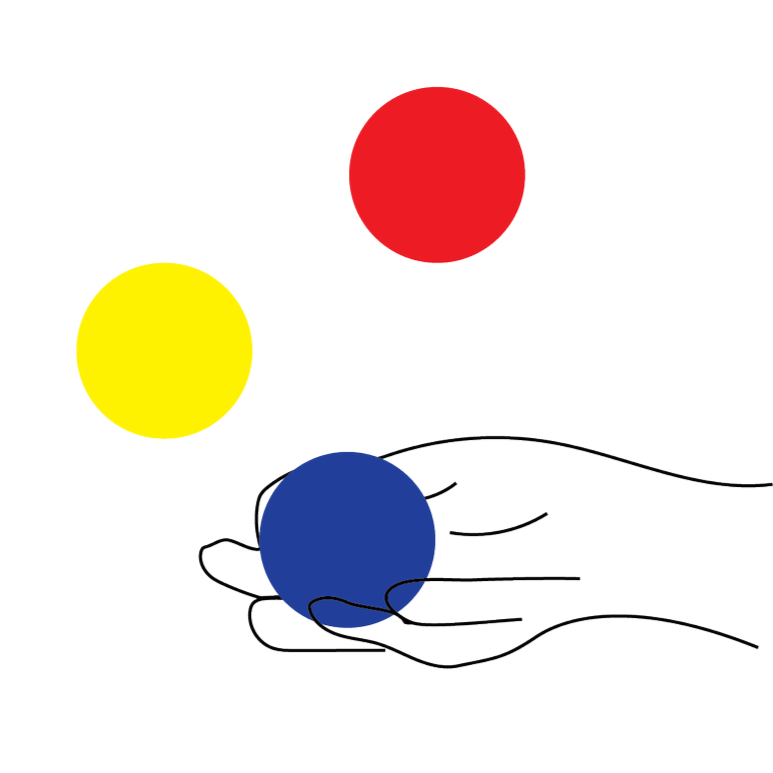
Throw the ball up, “And see what happens.” A mindfulness expression
Core thought:
Parse: to analyze
Scaffold: Learn to Learn to Learn
The key benefit of progressing with juggling is breaking down any new task into small, achievable goals: scaffolding. Juggling continues to reinforce “learning to learn,” which leads to: progressive scaffolding, development, and achievement.
Parse: to break down
Scaffold: to build up
One main thing Juggling teaches is “Learning to learn.” From Learning to learn to learn, parsing and scaffolding, these principles can be applied to everything new. Remembering that learning requires dropping the ball.
Conversation Starters:
Learning to Learn to learn- Scaffolding
Every toss breaks a rut. R.U.T.T.
Risk, Uncertainty, Thrill, Triumph
There is just Try and See what happens (ambivalence)
Discernment versus judgement (no judgement)
Intra Parietal Sulcus versus cortex
Pass is paramount (perceive the pass)
Whatever I say, the opposite can be true
Paradox of juggling and its process
the quiet eye , “The EYE is window into the mind.”
Pause allows the brain to process “dwell time.”
Dwell time before pass “hesitate and see it” to the tune of “Ice Ice Baby.”
The group creates collective effervescence (from Jump Math - John Mighton)
It’s the opportunity to learn something new as a group
Juggling and ecstasy - the passing connection
Japanese proverb - when you are 90% there, you are halfway
Passing produces initial frustration
But when it gels, it leads to extraordinary benefits, like choral singing has shown, a shared bond and a coordinated effort.
“Team cognition (gelling versus individuals forming a group) (social sluffing)
Gelling; coordination, cohesion, collective, efficacy
“Neuro - efficiency” of the group is confidence in oneself and trust in others.
Social sluffing is when an individual cares only about oneself,” - Edson Filho
Gelling results in workflow super-efficiency
Team chemistry, dynamics, synergy, melding, coordination
Right time, right thing, right reason
Four phases of group dynamics coming together:
storming, norming, forming, and performing
Find something positive in each practice
Lev Vygotsky “zone of proximal development” and “scaffolding.” Building up with small successful increments.
Measurable, milestones, mini moments
“Ambivalence creates motivation,” a message from Doctor Miller in Maureen Palmer’s book “You don’t have to quit.” It is a message from AA.
Process over outcome
Ambivalence leads to accepting, and then allows for progress.
When Ambivalent, no other reason except for the sake of the “process.”
Ambivalence from Christine Hassler, “Expectation Hangover”, full engagement with low attachments, passionate about the process
Blaine the Magician: accept where you are in the process to progress, and enjoy diligent practice.
Gabrielle Oettingen, in the book “Rethinking Positive Thinking”: “W.O.O.P.S. strategy.”
Wish
Objective
Obstacle
Plan
Start
“Good better best, never let it rest, till your good is better, and your better best.”
“Does anyone have any questions for my answers?”
“Guarantee, learn to learn to learn to juggle.” Like Stephen Pinker’s book: When you know that I know that you know.
“Due to the popularity of pickleball, juggling is like playing pickleball by yourself.”
“A dropped ball is a chance for the brain to recalibrate and make adjustments and try again on its own through the ideomotor and the intraparietal sulcus.”
The intraparietal sulcus does all the good stuff that juggling activates:
spatial
visual
movement planning
coordination
Ideomotor:
Focuses on the mental muscle process of movement memory
It’s the mental process of movement
Muscle Memory
Practice Process over outcome
Which is throws versus catch
The paradox of the beginner versus the process:
Beginner initially throws with failure on purpose to see the pattern
The process throws with purpose and success to progress
Ideomotor:
Is where your muscle memory helps beyond just seeing
Bit of a riddle: where you fail to see helps the senses
Easy once you can do it!
Decision Training, hard first principle, Joan N. Vickers
Set a goal or decision
Struggle, stimulate, scaffold
The struggle stimulates the neural network to start thinking, and then the practice can begin.
First, you make mistakes, then you correct them. “That’s the Hard first principle.” Motivates the mind to learn.
Where you look, the ball has already been tossed
The thought, thinking, or change-up happens two or three tosses early.
Thinking comes from the cortex (beginner process), flow comes from the intra-parietal sulcus (ideomotor).
Juggling relates the Zen Buddhist Mindfulness: 4 pillars: awareness of body, feelings, mindset and mental outlook.
The Chinese Bamboo tree: a powerful parable for patience and persistence. As the gardener waters and consistently cares for the sapling for 4 years as it shows no visible growth, yet continues to establish a strong root system. In 5th year it grows up to 90 feet in 6 weeks. The parable shows that sustained practice can lay a solid foundation for seemingly and surprising rapid success.
The Parable, trusting the process and patience: Bamboo tree
“The Eyes are a window into the Mind.” Watch the eyes! Once the juggler is relaxed and ready to receive the pass the eyes will be very “Quiet.” You can imagine what goes in the mind when you see the eyes darting all over the place. You can imagine the panic. The eyes dart all over the place when you prepare for a change up in routine path, there is a bad throw, a distraction. Side note: why backchecking distracts player which helps distract opponent.
“When the student is ready , the teacher will appear.” You know the pattern is solid when the eyes are calm: “Quiet Eye.” Joan N. Vickers explains that “quiet Eye” benefits are relaxed muscles around the eye translating all through the body. A “Quiet Eye,” allows relaxed muscles to perform at their best. This practicing is also an example of when then student is ready the teacher will appear. When the eyes do finally relax, quiet eyes, and we call the pattern “solid,” you are ready for the next step. Whoever tells you the next step when you have a solid base and are ready will appear to be the teacher.
When the throw is consistent-”Solid” you are ready for the next step. “The teacher will appear.” “The teacher will appear,” is a saying that infers that change will come after the previous step is “Solid.”
“the eyes are a window into the mind” where a “Quiet Eye” indicates a quiet mind, calm and relaxed. Picture the eyes of a race car driver seen at the start line. Darting eyes would give a sense of panic.
Legitimate reasons of inability. Can we still “trust the process?” The book about alcohol abstinence says that ambivalence is a positive state of mind, wondering what might happen, going forward that helps relax and not put too much weight or focus on the goal. Ambivalence paradoxically helps focus on the process by not worrying about the goal. A spiritual guru said that it helps to stay in the present by not worrying about the future.
“The Pass is Past.” Look up at the Ball and realize it has already been thrown. The processing for throwing the next ball has already occurred. Any thought you may have are coming from your Frontal lobe, for forethought, but the action is already occurred in the intraparietal Sulcus. Throw the ball up and “See what happens.” A mindful expression.
“R.U.T.” look for an expression that explains the depression in thought that comes with every new attempt followed by a wait and see attitude. I came up with Risk Uncertainty and Thrill to spell the mnemonic RUT. Coincidently, my daughter an artist working with the dean of Arts at Emily Car School of Arts, were looking for 3 words that encapsulated what an artist feels when they work. Those words were Risk, Uncertainty and JOY.
Eye of the Champion: This dip and rise was also seen in the book “Eye of the Champion” explaining the Dummy Keuger Effect where after every beginners luck there is a dip of performance and then a long time practicing in the valley of despair before a gentle rise in competency.
The Dummy Kreuger effect normally means People with less knowledge who are overconfident. Dummy Kreuger Graph for stages of development.
First a burst of ability, beginners luck. A potential result
Next a long time of Uncertainty trying to replicate initial result
Then the long road of process, progress towards competence.
Discernment or Pause gives your brain time to adapt.
What does “Regress to Progress” mean? Sometimes it means that when we make a change that it will feel worse initially, different than we are used to. Other times it can mean that we have to take a small step back so that we are fully capable of practicing with success. So we can enjoy the process of practice and develop a routine that can be challenged when ready. “When the student is ready, the teacher will appear.”
Stages of learning:
Almost impossible
I think I will try
I might get this process
Hey how am I doing this step?
Wow. How did that happen? Practice and Process
Practice and Process!
After Dropping A Lot, I thought why not continue throwing up and I will watch my thoughts as I improve. Believe me, I had some negative thoughts. These thoughts tend to still come back at every new stage as I watch my thoughts and persist and acknowledge a new stage.